If it’s missing, so may be investment.
A critical piece is missing from the Greenhouse Gas (GHG) Protocol’s latest direction of travel for the revised Scope 2 Guidance: a legacy contract provision.
Since 2025, corporate energy buyers have procured over 50 gigawatts (GW) of carbon emissions-free power with the understanding that the long-term power purchase agreements (PPAs) that count under the current Scope 2 rules would continue to be recognized. But the GHG Protocol’s latest iteration of the Scope 2 Guidance unexpectedly lacks a legacy provision that would protect those contracts.
Instead, the GHG Protocol proposes a single, uniform effective date, after which every contract, including PPAs signed under today’s rules, must meet new hourly matching, deliverability, and incrementality tests to count toward market-based Scope 2. This means that a company that signed a 15-year PPA to bring new wind or solar onto a dirtier grid could lose credit for that investment while the PPA is ongoing.
This is a shocking revelation and reversal: For two years, the GHG Protocol gave the impression that a legacy clause was part of the package. Without a strong legacy clause, companies may think twice before signing long-term contracts that are critical to financing new clean power. CEBA fervently hopes that the GHG Protocol will reconsider and quickly announce its commitment to a legacy clause.
Overwhelming support
The legacy clause was uniformly supported. Stakeholders endorsed it, the GHG Protocol’s Independent Standards Board (ISB) voted for it, and the GHG Protocol itself promoted it. Now it’s gone.
The public: 90% support. The 2026 public consultation drew nearly 1,100 responses from 56 countries. Of the more than 800 respondents who commented on the legacy clause, 90% supported it.
Support held in every region. Respondents warned that changing rules without a legacy clause could strand long-term PPAs, undermine investor confidence, and discourage future investments in carbon emissions-free projects.
The ISB: a 10–1 vote. On July 14, 2025, the ISB approved development of a legacy clause that could allow existing long-term contracts that met the current Scope 2 Guidance to continue counting even if they do not meet hourly or deliverability requirements. Even the ISB members that had reservations noted that they were concerned about permanent exemptions, not about protecting existing contracts.
GHG Protocol: on the record, repeatedly.
- August 2025: The ISB-approved draft included a legacy clause for long-term contracts.
- September 2025: A legacy clause “is being developed to ensure investments made under existing scope 2 accounting rules are appropriately recognized.”
- October 2025: The consultation launch named a legacy clause among its core feasibility measures.
Then, in October 2026, the legacy clause disappeared.
In its place, the GHG Protocol’s direction of travel proposed a single uniform effective date. This approach was offered as an alternative during the consultation, though stakeholders consistently favored the legacy clause.
Why clean energy investments are worth protecting
PPAs get clean energy built. When a company signs a PPA, it commits to buy a project’s power and potentially Energy Attribute Certificates (EACs) for typically 10–20 years, giving developers the revenue certainty lenders need to finance construction. Over the past 15 years, corporate PPAs have been associated with financing roughly 200 GW of new renewable capacity. Corporate buyers’ commitments also represent more than 40% of the new U.S. clean energy capacity added over the past decade.
PPAs help stabilize the market. CEBA-commissioned research by Resurety analyzed 251 wind and solar projects across ERCOT, MISO, and PJM. Long-term corporate virtual PPAs cut the share of projects in financial distress by 90% in MISO and PJM and by 80% in ERCOT. EAC revenue alone reduced financial distress by 30%. Stable revenue keeps projects operating through dynamic power markets, and it’s exactly what’s at risk if PPAs stop counting for the buyers who signed them.
PPAs let buyers invest where it matters most. Wind and solar projects are sited where resources are strongest, which often isn’t where a buyer’s facilities are located. Companies with load spread across many regions can aggregate that demand and use their balance sheet to anchor one large, high-performing project. Companies that aggregate load across regions to reach PPA scale and impact may lose that option under a deliverability requirement.
A legacy clause protects today’s investments
Long-term PPAs are one of the most impactful forms of clean energy procurement because the buyer’s commitment underwrites the financing that gets new projects built. They are also the contracts that a uniform effective date would hit hardest.
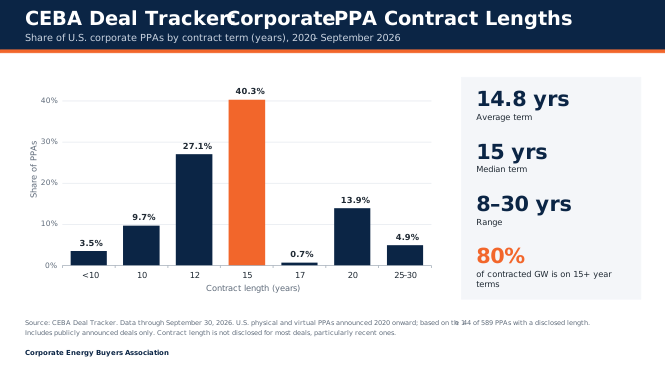
PPAs run approximately 15 years on average, according to CEBA’s Deal Tracker. A 15-year PPA signed today and delivering power from 2028 to 2042 would spend 10 of its 15 years under the new rules. The buyer that paid for the contract would lose the Scope 2 recognition it signed the contract to secure for two-thirds of the deal’s lifetime.
This matters beyond existing contracts. Lenders often base a project’s financing around the length of its PPA, so long-term contracts are especially valuable for getting new clean energy projects built. If buyers respond to the new rules by signing shorter contracts, or none at all, projects can borrow less and financing costs will rise, resulting in fewer new clean energy projects making it to construction.
Among PPAs with disclosed terms, about 80% of capacity is contracted for 15 years or longer; if that holds across all PPAs tracked since 2020, it would represent an estimated 69 GW.
Bring back the legacy clause now
CEBA calls on the GHG Protocol to bring back the legacy clause.
Scope 2 uncertainty is already chilling investment. Corporate buyers announced a record 27 GW of U.S. clean energy in 2025, but that volume came from fewer companies: the number of buyers making clean energy announcements fell 40% year-over-year.
The contraction has continued into 2026, and market participants point to Scope 2 as part of the reason. In a flash poll at CEBA’s 2026 Summit, more than 75% of respondents said legacy clause uncertainty was already impacting their procurement decisions. Half of the respondents said they had delayed or paused procurement decisions pending clarity on the Scope 2 legacy treatment.
While the GHG Protocol can’t fix interconnection delays or rising project costs, it can remove the uncertainty it created and announce a legacy clause that honors existing contracts.
What the GHG Protocol should do:
- Recognize contracts that qualify for claims under today’s Scope 2 Guidance and were signed before the revision’s publication, for their full term
- Announce this now as a firm commitment, not left open until the final Guidance is published in 2028
The buyers that made long-term commitments under today’s Scope 2 Guidance should not be the ones penalized for a change in direction from the GHG Protocol. The legacy clause is not lost; the GHG Protocol just needs to put it back.
For more information about the GHG Protocol’s legacy clause, contact Misti Groves. For press inquiries, contact our Communications team.