The clean energy transition needs every tool we can bring to the table. Wind, solar, hydropower, storage, advanced nuclear, geothermal, and carbon capture and storage (CCS) each play a critical role in building a reliable, low-carbon grid.
CCS offers a pathway to dramatically reduce emissions from natural gas generation that the grid depends on today, and it is likely to rely on for decades. As a result, CCS is emerging not as a competitor to renewables, but as an essential complement. And corporate buyers are uniquely positioned to help bring early projects to market.
Resource
For a deeper dive on the opportunities CCS provides corporate buyers, download our primer.
Natural gas isn’t going away. Its emissions don’t have to stay.
Natural gas provides a significant share of electricity generation in the U.S. Even with rapid solar growth, the U.S. Energy Information Administration projects that gas will supply around 25% of U.S. electricity through 2050. It remains the grid’s primary source of firm power, the power that’s available anywhere, anytime.
But without mitigation, natural gas generation will remain a significant source of CO₂ emissions.
CCS changes this equation. By capturing and storing 90% or more of CO₂ emissions from natural gas plants, CCS enables firm, dispatchable power with a lower carbon footprint.
CCS technology is proven — and now scaling to power.
While CCS deployment on natural gas power plants is still emerging, the underlying technologies are well established. Carbon capture has been used for decades in industrial settings, and geologic CO₂ storage has a long track record of safe, durable performance.
Today, the first full-scale natural gas power projects with CCS are under development and expected to begin operating between 2028 and 2030. These early projects — located in regions like the Gulf Coast, Midwest, and Mountain West — can demonstrate how CCS can deliver clean, firm power at scale.
These first-of-a-kind projects are critical but face real hurdles. Even with strengthened U.S. tax incentives (like the enhanced 45Q credit), early CCS deployment still requires long-term revenue certainty to move forward.
That’s where corporate energy buyers can make a difference.
Corporate buyers can bring the next generation of clean energy online.
Corporate energy buyers have shaped the modern carbon emissions-free electricity market, announcing over 130 GW of clean energy deals in the U.S. since 2014. Early commitments from major companies helped wind and solar scale dramatically and catalyze the market, moving from a handful of buyers in 2014 to 250 by the end of last year.
Today, buyers have a similar opportunity to help bring the next generation of clean energy online. Here’s why CCS should be on energy buyers’ radar:
1. Load growth is driving new gas, and it must be lower carbon.
Energy load growth means additional natural gas plants are in queue. Natural gas generation needs to be equipped with technologies to capture and sequester carbon to avoid locking in long-term emissions.
2. Corporate commitments can unlock early projects.
Long-term offtake agreements from corporate buyers can derisk early CCS projects and accelerate deployment. The faster CCS scales, the faster the cost curves improve — just as they did for renewables — improving affordability.
3. CCS fits in carbon accounting.
Buyers can get credit for emissions reductions from CCS investment under existing GHG Protocol accounting guidance. Energy Attribute Certificates (EACs) for CCS may provide even more transparency and standardization.
Google’s CCS offtake is an early market signal.
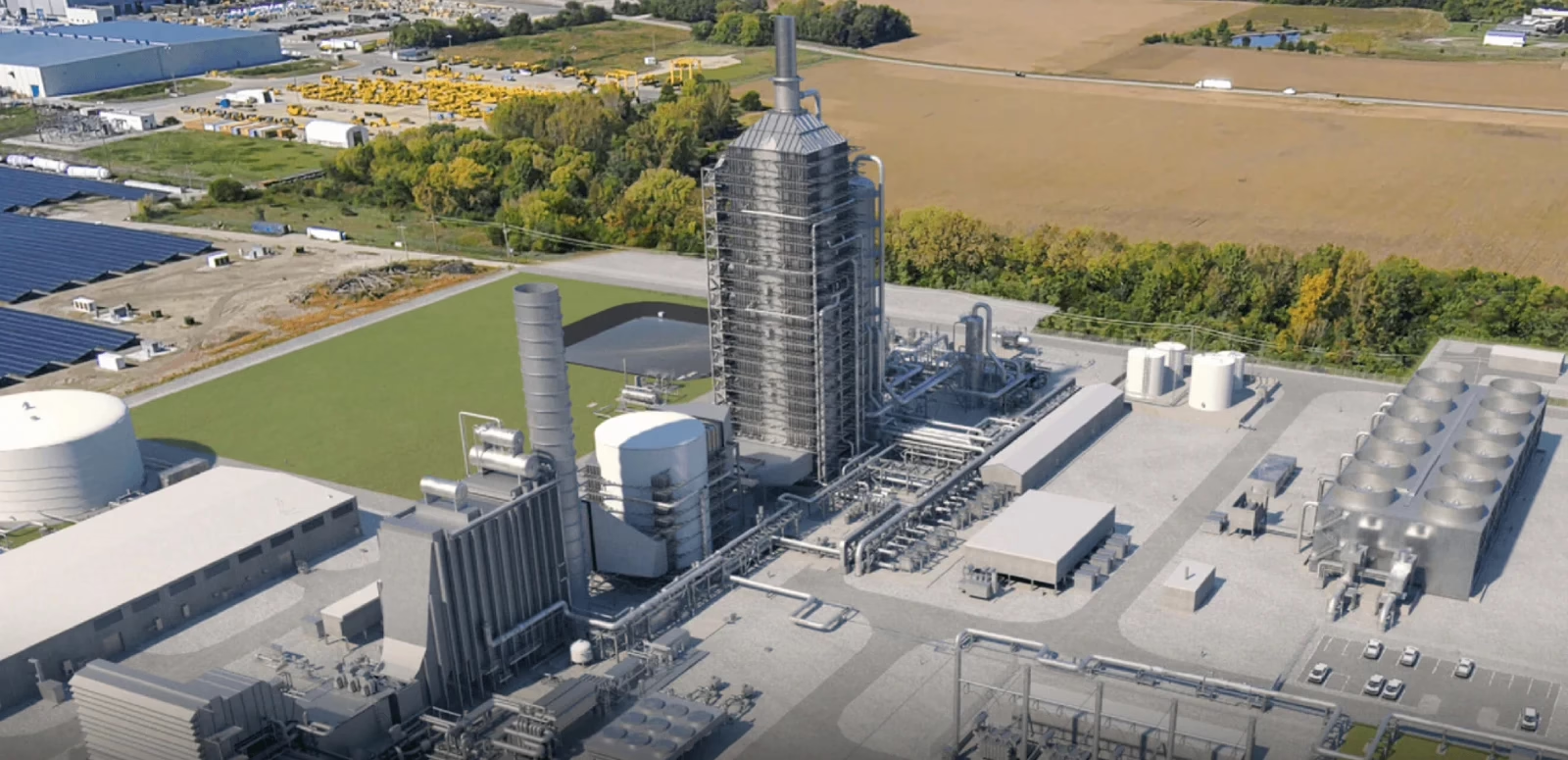
One of the clearest signs that CCS is primed for corporate energy strategy is Google’s agreement to support the Broadwing Energy project in Decatur, Illinois — a 400 MW natural gas plant with CCS projected to capture around 90% of its CO₂ emissions. It also underscores that CCS is being evaluated — and embraced — not as a replacement for renewables, but as a necessary complement.
Bottom line: Corporate buyers helped make renewables a global success story. They can play the same catalytic role for clean firm power next.
Engage with CEBA’s upcoming events to learn more about CCS:
1. Anyone can join CEBA’s upcoming CCS webinar on April 16 at 1 PM ET. If your organization is planning new load, expanding data center operations, or preparing for evolving Scope 2 rules, now is the time to explore where CCS fits into your decarbonization roadmap.
2. Energy Customer members can join CEBA’s Energy Customer Boot Camp in Washington, D.C., June 16–17. Energy Customer members will explore how to integrate variable renewables with clean, firm resources such as CCS, storage, and geothermal. Register today and learn how CCS can strengthen your decarbonization strategy.
3. Engage in the CCS EAC. A proposed methodology for Energy Attribute Certificates (EACs) at power plants using carbon capture and storage was released in late 2025. The methodology is open for public input and comments from April 6–June 6. Participate in the process.