As America enters a new era of electricity demand growth, corporate energy buyers are increasingly investing in geothermal projects to power their growing operations.
Notably, recent technological advancements in geothermal have enabled much larger projects that can scale up to meet the demands of large energy customers, while also opening new areas of the U.S. to geothermal development. Together, these advances are making geothermal an increasingly attractive resource for CEBA members.
The U.S. needs more reliable, resilient, and affordable energy resources. New and growing economic sectors, including advanced manufacturing, electrification, and artificial intelligence, are increasing electricity demand.
Geothermal energy has the potential to play a critical role in America’s energy portfolio because it can deliver affordable, clean, baseload power: qualities that matter most to large clean energy buyers.
Momentum around geothermal is growing rapidly — and for good reason.
New technologies are dramatically expanding where geothermal can be deployed. This reduces development challenges and unlocks scalable, always-available energy production across much larger portions of the country than previously thought possible.
How BAAJA Helps Geothermal
Congress has an enormous opportunity to help accelerate geothermal’s momentum with the Bipartisan American Affordability and Jobs Act (BAAJA), the energy permitting and transmission reform bill under consideration in the current Congress.
If passed, BAAJA would accelerate geothermal energy development by granting projects the same regulatory parity and categorical exclusions as oil and gas operators, streamlining environmental reviews for qualifying wells and transmission lines. BAAJA would also impose strict 30-day deadlines for federal agencies to review permit applications.
Electricity buyers support BAAJA’s permitting reforms because they would dramatically accelerate the delivery of affordable, 24/7 geothermal power — reducing development costs, minimizing project delays, and helping meet surging grid demand.
Geothermal Is Built for Reliability
One of geothermal energy’s greatest strengths is its ability to provide consistent, around-the-clock electricity.
As reserve margins tighten and electricity demand continues to climb, reliable generation resources are becoming increasingly valuable to maintaining grid stability and supporting economic growth. Geothermal facilities operate with extremely high capacity factors and provide dependable power all day, rain or shine.
That reliability matters enormously to large electricity customers. Data centers, advanced manufacturers, and major retailers all depend on a stable supply of electricity to operate continuously and efficiently.
More Affordable Electricity
Affordability was a top issue for voters during the recent midterm elections, making access to lower-cost electricity increasingly important for both American businesses and households.
Across many regions, electricity prices are facing upward pressure from growing demand, transmission constraints, infrastructure costs, and fuel market volatility. Expanding reliable generation resources is essential to maintaining affordable electricity over the long term.
Geothermal energy offers important cost-stabilizing advantages as well. Once operational, geothermal facilities can provide stable generation with predictable operating costs over very long time horizons. Because geothermal resources do not depend on fuel deliveries or global fuel markets, they can provide long-term price stability benefits that help reduce exposure to volatility.
Accelerating geothermal deployment can also help reduce stress on constrained electricity systems by adding additional firm generation capacity closer to growing load centers.
In many cases, geothermal development may also benefit from existing energy infrastructure, workforce expertise, and supply chains developed through decades of leadership in American energy production. That overlap creates exciting opportunities to accelerate deployment while supporting domestic jobs and economic growth.
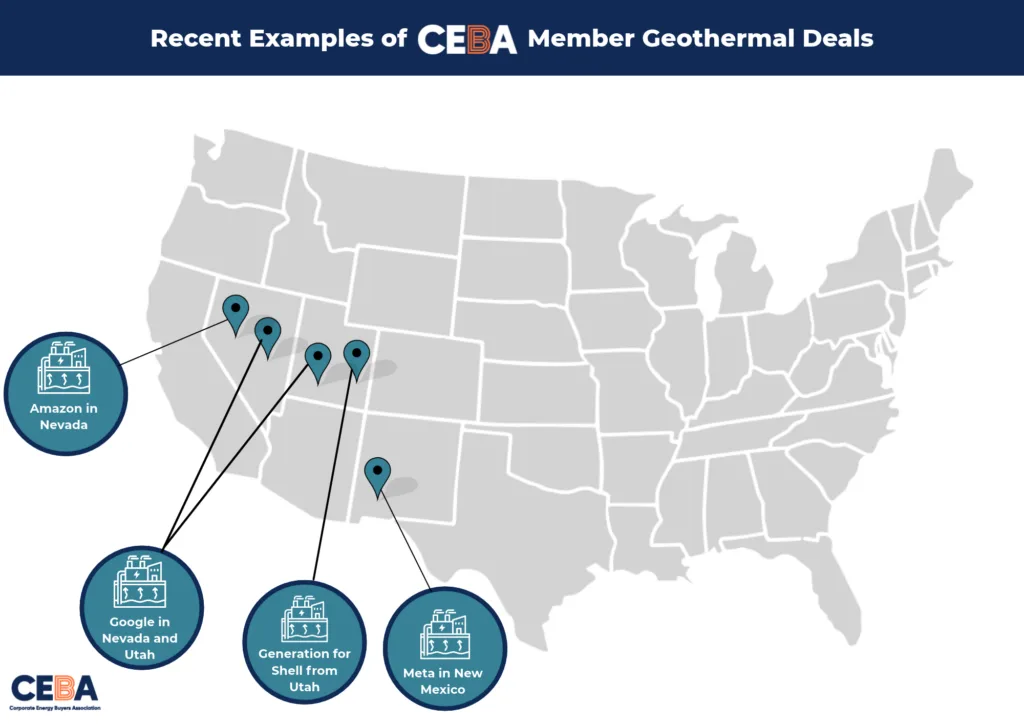
Google in Utah: In September 2026, Fervo Energy announced a 396-megawatt agreement with Google this year to support continued development of an enhanced geothermal project to help power a potential data center in the state.
Google in Nevada: In February 2026, geothermal developer Ormat Technologies entered into a long-term power purchase agreement with the utility NV Energy to support Google’s operations with 150 megawatts (MW) of new geothermal capacity.
Meta in New Mexico: In March 2026, geothermal developer XGS Energy and energy technology company Baker Hughes announced a collaboration on a 150-MW project in New Mexico to support Meta’s data centers.
Shell in Utah: In April 2025, Fervo Energy announced the execution of a 15-year power purchase agreement with Shell Energy for 31 MW of power from a Utah-based geothermal plant to serve Shell’s retail customers, beginning in 2026.
America Has a Big Opportunity to Lead
Even more exciting is the rapid advancement of enhanced geothermal systems and closed-loop geothermal technologies. These innovations are expanding geothermal’s potential far beyond traditional hydrothermal regions in Western states and creating opportunities for deployment in other parts of the country.
The U.S. could be on the verge of unlocking an entirely new category of reliable, domestic, carbon emissions-free energy production.
And the excitement around geothermal extends well beyond electricity generation alone.
The U.S. has a tremendous opportunity to become a global leader in advanced geothermal innovation and deployment. Many of the technologies required for next-generation geothermal development align closely with American expertise in drilling, subsurface engineering, and energy infrastructure development.
That creates opportunities not only for new electricity generation, but also for domestic manufacturing growth, workforce development, technology exports, and energy leadership.
As countries around the world search for reliable and scalable energy solutions, America has an opportunity to lead the development of technologies that could shape the future of global energy systems.
Policies Help Unlock Geothermal’s Potential
Despite growing excitement and technological progress, geothermal deployment still faces important barriers.
Drilling risk is widely viewed as the geothermal industry’s greatest financial and geological challenge. Without direct visibility into the resource, exploration risks “dry holes” (inadequate water, heat, or permeability), compounded by high upfront costs and mechanical hazards.
Project developers also often encounter lengthy permitting timelines, financing challenges, transmission constraints, and regulatory frameworks that do not fully recognize the reliability and resiliency benefits geothermal provides.
In addition to passing BAAJA, Congress can help accelerate deployment by passing federal legislation focused on:
- Establishing a federal drilling risk-sharing or “appraisal risk” program, including cost-share grants or co-financing of deep exploratory drilling
- Streamlining permitting and environmental review processes for geothermal projects while maintaining strong environmental protections
- Expanding support for demonstration projects and commercialization of advanced geothermal technologies
- Improving access to federal financing tools and loan programs
- Supporting transmission infrastructure upgrades needed to connect new generation resources
- Modernizing electricity markets to appropriately value firm, dispatchable carbon emissions-free resources
- Strengthening partnerships between the federal government, national laboratories, universities, utilities, and private industry
- Preserving long-term policy certainty that enables durable private sector investment
The geothermal industry is advancing quickly, but long-term policy support and regulatory clarity will be essential to scaling deployment.
States also have a major opportunity to accelerate geothermal development. Utility regulators and state policymakers can help ensure geothermal resources are fully considered in utility planning processes and resource procurement decisions. States can also modernize permitting frameworks, support workforce development programs, encourage pilot projects, and create pathways for innovative procurement structures.
Importantly, states should recognize geothermal not simply as another energy resource, but as a technology that can help strengthen reliability, improve resiliency, and support long-term economic competitiveness.
The Time to Act Is Now
Geothermal energy is no longer a niche technology with limited potential.
Rapid technological innovation, growing electricity demand, and increasing focus on grid reliability are creating a major opportunity for geothermal deployment in the U.S.
The momentum is real. The technology is advancing. Now is the time for Congress and states to act boldly to accelerate geothermal deployment and unlock one of America’s most promising energy opportunities.